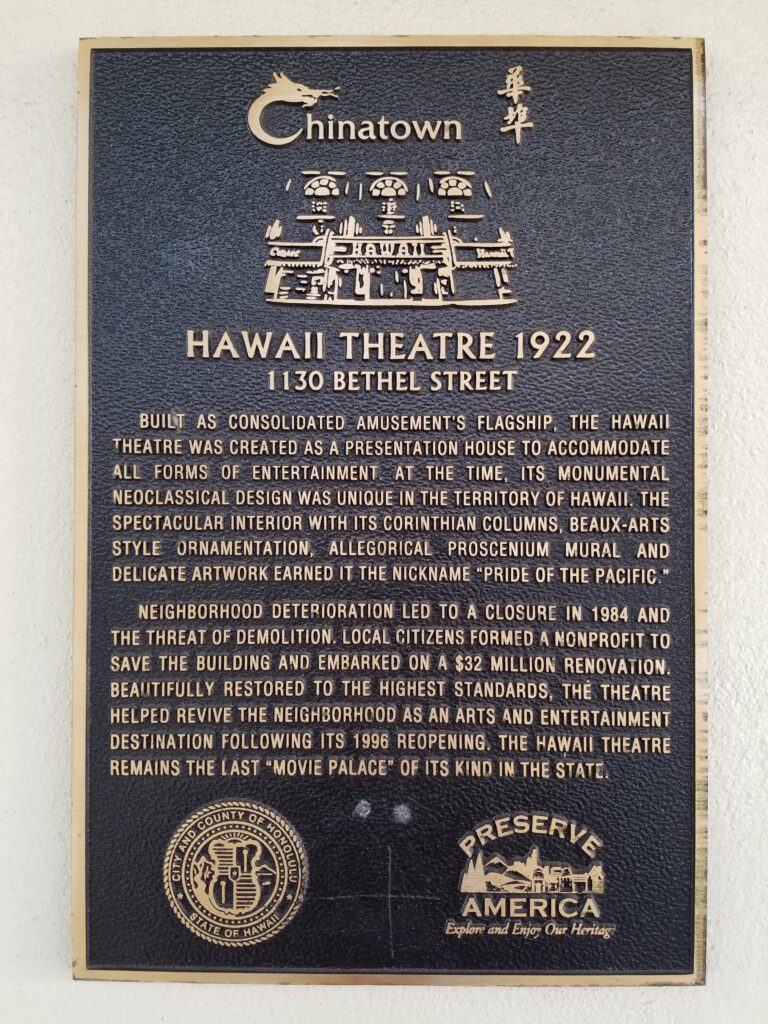
The Hawaiʻi Theatre in Honolulu stands as the crown jewel of the Chinatown Arts and Culture District, representing a masterclass in architectural synthesis and a monumental triumph of grassroots preservation. Known historically as the “Pride of the Pacific,” this 1922 landmark escaped imminent demolition in the late 1980s through an extraordinary $32 million community-led rescue campaign. Today, the theatre is the last surviving, operating historic theatre in Honolulu, serving as both a functional performing arts anchor and a physical monument to the power of citizen activism.
Architectural Majesty: A Hybrid of Classical and Art Deco Forms
Designed by prominent Honolulu architects Walter Emory and Marshall Webb, the Hawaiʻi Theatre opened on September 6, 1922, as the flagship venue of the Consolidated Amusement Company. Built upon a solid coral foundation with a reinforced concrete skeleton, the structure was hailed as an engineering marvel, featuring a highly advanced double cantilever system to support its massive balcony without obstructing sightlines.
Architecturally, the building is a highly rare, eclectic hybrid that reflects the shifting design paradigms of the early 20th century.
The Exterior and the Iconic Neon Marquee
The facade showcases strict Neoclassical symmetry, accented by paired Corinthian columns, pilasters, and Roman-arched window openings. Woven into this classical framework are delicate Byzantine and Moorish decorative accents.
While the theatre originally featured a modest canopy, its exterior identity was fundamentally transformed in 1938 with the installation of a massive Art Deco marquee. Boasting the largest neon display in the islands, the brilliant vertical “HAWAII” blade sign and computerized marquee serve as a beacon for downtown Honolulu.
The Interior Sanctuary of Beaux-Arts Elegance
Stepping into the auditorium reveals a breathtaking display of Beaux-Arts opulence. The space is intentionally wide and shallow, optimized for acoustic intimacy and uncompromised sightlines across its main floor and single balcony. Key historic features include:
- The Proscenium Mural: Titled “The Procession of the Drama,” this sprawling masterpiece painted by celebrated artist Lionel Walden crowns the stage, depicting allegorical figures in mid-dance.
- The Gilded Dome: A massive, recessed mosaic ceiling dome utilizing indirect lighting systems that cast a soft, ethereal glow over the audience.
- Classical Plasterwork: The proscenium arch is framed by intricately molded plaster maile leaves—a Hawaiian cultural touch echoing Greek laurel wreaths.
- Balcony Bas-Reliefs: Flanking the upper tiers are striking sculptural reliefs depicting scenes from Shakespeare’s Hamlet and The Merchant of Venice.
The Heartbeat of Chinatown: Cultural and Economic Anchorage
The location of the Hawaiʻi Theatre at the intersection of Pauahi and Bethel Streets places it at the absolute nexus of Honolulu’s historical shifts. Throughout the 1920s and 1930s, the theatre thrived as a premier venue for traveling Vaudeville troupes, silent films, theatrical plays, and traditional Hawaiian musical revues. During World War II, it operated around the clock, providing vital escapism and entertainment for thousands of military personnel stationed in the Pacific.
As the mid-century approached, the rise of television and the shift of commercial development toward Waikiki and suburban malls triggered a severe decline in downtown attendance. By the 1970s and 1980s, the surrounding Chinatown district fell into economic depression, marked by urban decay and neglected storefronts.
When the theatre finally darkened its stage in 1984, the roof was failing, rain was actively destroying the priceless Walden mural, and the landowners planned to bulldoze the structure to build a parking lot.
The successful preservation and reopening of the venue in 1996 served as the definitive catalyst for the birth of the Honolulu Chinatown Arts District. The influx of theatre patrons revitalized the economy, breathing new life into local businesses. Cheap neighboring rents suddenly became highly attractive to artists, restaurateurs, and independent boutique owners.
Today, the theatre anchors the neighborhood’s celebrated First Friday Art Walks, as well as presenting over 200 show days per year, drawing tens of thousands of visitors monthly and proving that architectural preservation can directly drive urban economic renewal.
The Rescue: Early Donors, Volunteers, and the American Theatre Organ Society
The survival of the Hawaiʻi Theatre is not merely a story of real estate preservation; it is a testament to extraordinary human intervention. When the venue closed in 1984, a small, highly passionate collective refused to let the building vanish.
The Catalyst: The American Theatre Organ Society (ATOS)
The very first line of defense came from the Aloha Chapter of the American Theatre Organ Society (ATOS). This dedicated group of pipe organ enthusiasts had long cared for the theatre’s crown jewel: a rare 1921 Robert Morton Unified Orchestra Theatre Organ. Knowing that demolition meant the destruction of this irreplaceable musical instrument, members of ATOS mobilized the wider community.
On April 28, 1984, these activists formally incorporated the Hawaiʻi Theatre Center (HTC) as a 501(c)(3) non-profit organization, with Frank Loney serving as its founding president.
The Grassroots Hustle
The early volunteers engaged in grueling, hands-on preservation work to stabilize the crumbling structure. With minimal funding, teams of citizens spent weekends patch-repairing leaking roofs, sweeping out debris, and cleaning mold from the vintage seats.
In an extraordinary display of dedication, volunteers carefully salvaged loose flakes of genuine gold gilding that had peeled off the deteriorating walls, gathering and selling the precious metal to funnel every single penny back into the restoration fund.
The Critical Benefactors
While grassroots volunteerism kept the building standing, securing the underlying land from the Bishop Estate required substantial capital. In July 1987, local businessman and philanthropist John H. Magoon Jr. made a foundational donation of $500,000. This critical financial injection allowed the HTC to exercise its purchase option, officially saving the physical property from commercial developers. Magoon’s family was the original developers of the theatre in the early 1900’s, as the founders and owners of Consolidated Amusements. Under the leadership of Robert Midkiff as Board Chair, the Theatre’s President & CEO Sarah Marks Richards, volunteer board members and community leaders worked tirelessly to mobilize the entirety of Hawaii to save the last great remaining show palace in the islands.
This monumental gift sparked a massive, decade-long fundraising campaign that eventually generated over $32 million from local families, private estates, and corporate foundations. Prominent entities like the Weinberg Foundation provided transformative grants—honored today via the main auditorium’s designation as the Weinberg Auditorium.
Renowned architect Malcolm Holzman of the New York firm Hardy Holzman Pfeiffer Associates was commissioned to lead the painstaking restoration, ensuring the interior mirrored its exact 1922 glory when it finally reopened on April 26, 1996.
Comparative Architectural Context
To understand the rarity of the Hawaiʻi Theatre’s specific preservation, it helps to compare it to other historical entertainment structures across the Hawaiian Islands:
| Theatre Name | Location | Built | Primary Architectural Style | Current Status |
|---|---|---|---|---|
| Hawaiʻi Theatre | Chinatown, Honolulu (Oʻahu) | 1922 | Beaux-Arts / Neoclassical / Art Deco | Fully Restored; Operating Arts Center |
| The Palace Theater | Hilo (Hawaiʻi Island) | 1925 | Beaux-Arts Style Concrete | Active Non-Profit Venue |
| Honokaa People’s Theatre | Honokaʻa (Hawaiʻi Island) | 1930s | Plantation-Era Community Hub | Preserved via Community Crowdsourcing |
| Queen Theatre | Kaimukī, Honolulu (Oʻahu) | 1930s | Art Deco Movie House | Abandoned; Seeking Renovation |
Stewardship and the Modern Era
Preservation is not a static historical event; it is an ongoing, multi-generational commitment. Having passed its centennial milestone, the Hawaiʻi Theatre Center continues to face the steep physical and financial realities of maintaining a century-old historic structure.
The theatre recently completed a vital $1.5 million exterior restoration project overseen by President and CEO Gregory Dunn. This comprehensive effort repaired decades of concrete spalling, addressed deep structural rebar rusting, refurbished historic windows, and completely repainted the outer facade to match its historical color scheme.
Simultaneously, the non-profit navigates an incredibly complex financial landscape, marked by a fourfold increase in property insurance premiums following recent climate events across the islands. To combat these operational strains, modern philanthropic leaders continue to step forward in the spirit of the early donors.
In April 2026, a critical $150,000 grant from the Swalm Family Mālama Keiki Initiative provided essential funding to repair extensive storm damage to the historic roof and marquee. This donation serves as a modern matching challenge, rallying the local community to raise an additional $450,000 to keep the venue accessible to local hula hālau, youth educational programs, and local theater troupes.
From the organ enthusiasts of 1984 who literally scraped gold from the walls to the modern patrons funding concrete repairs, the historic Hawaiʻi Theatre remains a living, breathing testament to the community. It stands as a physical reminder that architectural treasures endure only when a community chooses to love, protect, and actively sustain them.